

Sound Sensitivities: What Are They and How to Manage Them?
Written by: Gabrielle Talan
Gabrielle, a former insomniac turned sleep writer, brings over a decade of content expertise to her work. For the past 3 years, she’s focused exclusively on sleep topics – a happy choice that helps give her the deep and restful sleep she craves.
Medically reviewed by: Meredith Broderick, MD
Dr. Broderick is a triple board-certified sleep neurologist in Seattle, WA. She is passionate about sleep education and raising awareness about sleep disorders. You can learn more about her on her website, Sound Sleep Guru.
For most people, the everyday hum of a vacuum cleaner is background noise that’s easy to tune out. It’s sudden or loud sounds that grab their attention, like a plate breaking, the barking of a dog or the sound of emergency sirens.
However, for those with sound sensitivities, the same background noise can be distressing and even painful. Their brains process certain sounds more intensely, making everyday noise feel overwhelming.
Read on to learn about sound sensitivities, including the common types, causes, symptoms and management strategies.
Key Takeaways
Sound sensitivities are caused by the way the brain and nervous system process sound, leading to the perception of everyday noises as painful, threatening, or overwhelming.
There are five types of sound sensitivity: hyperacusis, tinnitus, misophonia, phonophobia and recruitment.
Management strategies can improve quality of life, and they include Cognitive-Behavioral Therapy, Tinnitus Retraining Therapy, and sound therapy, along with lifestyle changes and hearing aid use for recruitment.
Table of Contents
What Are Sound Sensitivities?
What Causes Sound Sensitivities?
What Are the Symptoms of Sound Sensitivities?
Types of Sound Sensitivities
What Is Living With a Sound Sensitivity Like?
Conclusion
Frequently Asked Questions About Sound Sensitivities
What Are Sound Sensitivities?
Sound sensitivity is an umbrella term for conditions that make everyday noises feel overwhelming or painful, affecting one or both ears. You might perceive sounds as too loud, unpleasant, or feel fearful or threatened by certain noises.
Noise sensitivities are more a matter of sensory processing than of the ears themselves. A person’s hearing may be perfectly normal, but the way their nervous system deciphers and responds to noise is exaggerated or distorted.
Noise sensitivity can also be a symptom of migraines, autism or a sensory processing disorder (SPD).
What Causes Sound Sensitivities?
Neurological and brain processing issues, such as abnormal brain connectivity and central auditory gain, can cause sound sensitivities.
A neck or head injury or long-term or single exposure to loud noise can also lead to sound sensitivity. Other culprits include ear infections, temporomandibular joint (TMJ) disorders, Meniere’s disease and otosclerosis.
Psychological factors like stress, anxiety, and trauma related to sudden, loud noise can also trigger sound sensitivities.
Sound sensitivities can also be symptoms of hearing loss, chronic fatigue syndrome, anxiety disorders, post-traumatic stress disorder (PTSD), autism and migraines.
What Are the Symptoms of Sound Sensitivities?
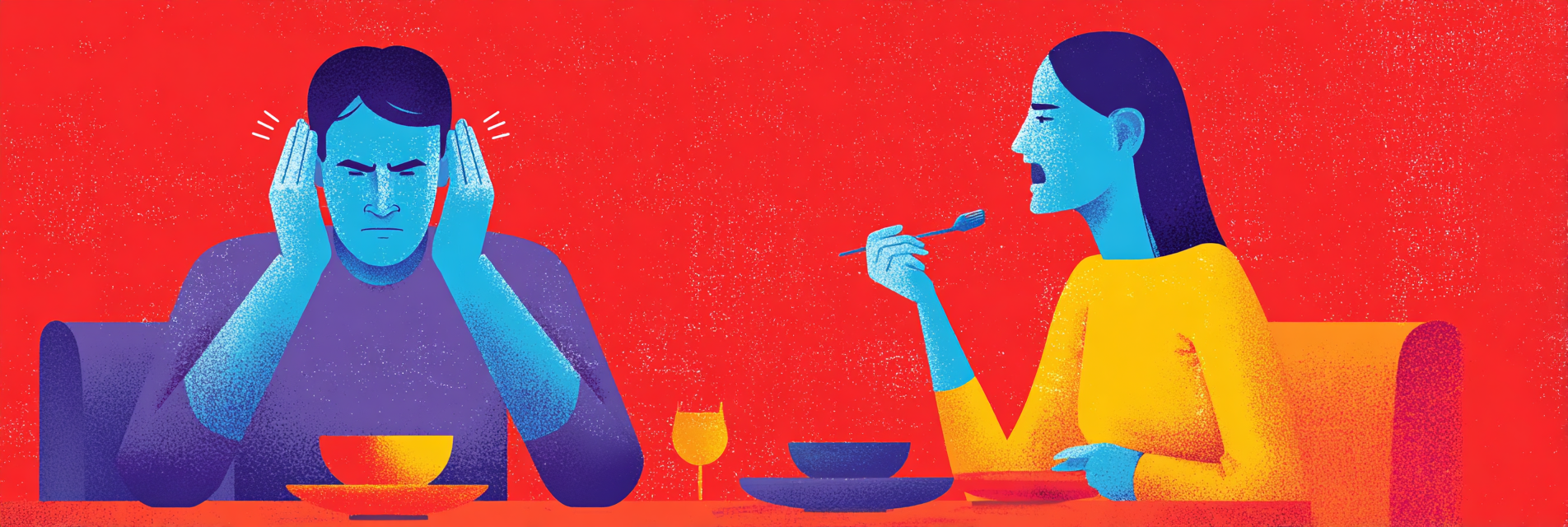
The main symptom of sound sensitivities is a negative response to a noise that others can easily tolerate.
Physical symptoms include ear pain and discomfort. You may also feel tense, nauseated, or dizzy. Emotional symptoms include anger, fear, anxiety and feeling overwhelmed. Behavioral reactions include avoidance, self-isolation and a need to control the sound environment.
Examples of triggering sounds include:
Repetitive tapping sounds
Burglar or fire alarms
Kids screaming
The screeching brakes of a bus or truck
Running water from a shower or faucet
A ticking clock
Chewing, slurping and other eating and drinking sounds
Types of Sound Sensitivities

We’ll discuss five common conditions related to sound sensitivity: hyperacusis, tinnitus (which often co-occurs with sound sensitivities), misophonia, phonophobia and recruitment.
Hyperacusis
Hyperacusis is when people perceive normal sounds as excessively or painfully loud. It’s a neurological issue, not a hearing problem, in which the brain processes normal sounds as overly loud, even when they fall within the normal range.
Causes of Hyperacusis
According to research cited in StatPearls, high noise exposure is the most prevalent cause of hyperacusis.(1) It can develop from a single event wherein you are exposed to an extremely loud noise, like a gunshot. It can also occur from long-term noise exposure, such as operating heavy machinery every day.
Another possible cause is damage to the facial nerve, which can result from Bell’s palsy and Lyme disease. Hyperacusis can also occur after ear surgery or during recovery from a concussion.
Scientists also theorize that a phenomenon known as central auditory gain causes hyperacusis, according to a study published in Frontiers in Neurology.(2) When the brain detects hearing loss, it overcompensates by amplifying noise, making it loud and even painful.
Hyperacusis also often affects people with tinnitus, Williams Syndrome or anxiety disorders.
Hyperacusis Symptoms
The symptoms of hyperacusis include ear pain (pain hyperacusis) or the feeling of fullness in the ears (like being on an airplane). You might also experience tinnitus and a reduced dynamic range, where the gap narrows between the quiet noises you can hear and the loud sounds you can tolerate.
While rare, research published in the Journal of the American Academy of Audiology found that hyperacusis patients reported a loss of balance, light sensitivity, headaches and sensitivity to strong smells.(3)
You might also feel constantly on edge, anticipating distressing sounds before they even happen. This state causes stress, anxiety and fear, which can make you avoid certain situations and environments.
Hyperacusis can get in the way of running errands, performing simple household chores, and working in an office. It can even rob you of simple pleasures, like listening to music. Given these challenges, depression and hopelessness aren’t far behind.
Management for Hyperacusis Patients
Hyperacusis management focuses on alleviating physical symptoms and on learning to cope with them psychologically.
Sound therapy involves retraining the brain to perceive noise as tolerable rather than unbearable. Patients are gradually exposed to consistent sounds, such as white noise or ocean sounds, at a comfortably low level. It eventually teaches the brain that sound is safe.
Cognitive behavioral therapy (CBT) works by altering the negative thought patterns and responses linked to the sound and reducing avoidance behaviors. CBT also teaches relaxation techniques that help patients manage stress and anxiety.
Lifestyle changes can also help, such as engaging in relaxing activities like yoga or getting enough sleep to prevent fatigue, which can lower tolerance to sound. You should also make smart everyday choices without avoiding certain situations, like choosing a quiet table at a restaurant.
Avoid self-isolating by telling friends, family and work about your condition. Join support groups to help you cope and feel less alone.
Other treatments, including nerve medication for pain hyperacusis, Silverstein surgery, and auditory integration therapy (AIT), are not yet supported by enough evidence to determine their effectiveness.
Tinnitus
Tinnitus is a ringing in one or both ears. You might also hear buzzing, clicking, hissing, humming, or roaring, which can sometimes be unbearably loud and lead to dizziness.
Technically, tinnitus isn’t a sound sensitivity to external noise, but it often co-occurs with sound sensitivity disorders.
Causes of Tinnitus
The causes of tinnitus range from inner ear damage to ear blockages and infections. However, the most common ones are noise-induced hearing loss and age-related hearing loss.
Certain medications that damage the auditory nerve or inner ear may cause tinnitus. A study published in the Journal of the American Academy of Audiology found that participants who were exposed to ototoxic medications were at a higher risk for developing tinnitus, especially those taking the chemotherapy drugs cisplatin and carboplatin.(4)
Tinnitus may also be a symptom of underlying conditions, such as Meniere’s Disease, TMJ disorders, neck and head injuries, and circulatory problems.
The Impact of Tinnitus on Daily Life
Tinnitus can make it difficult to focus during the day and sleep at night.
The discomfort and frustration can affect work, home life, and social interactions. You might also feel anxious and depressed, making you stop socializing. Also, imagine trying to fall asleep with a persistent ringing in your ears.
While all this may sound scary, don’t lose hope: tinnitus is manageable with the right strategies and treatments.
Tinnitus Management
There are several ways to manage tinnitus, including Tinnitus Retraining Therapy (TRT), CBT, bimodal therapy, protection from loud sounds, avoiding complete silence and stress management.
Tinnitus retraining therapy combines sound therapy and counseling. TRT trains the brain to identify the tinnitus signal as neutral by listening to neutral sounds at a level just below the tinnitus. The brain eventually learns to filter out the ringing in a process known as “habituation.”
CBT is the best-researched psychological treatment for tinnitus. CBT uses counseling to change your emotional response to tinnitus, as the condition can lead to anxiety and depression.
Bimodal therapy uses touch and sound to regulate abnormal brainstem cell activity. Tinnitus patients listen to a specific sound while an electrical pulse is applied to the neck, tongue or cheek. Eventually, the timing of the sounds and pulses tricks the brain into lowering the volume of the ringing.
Protection from loud sounds includes wearing devices, such as earplugs, in noisy environments to reduce tinnitus spikes. However, avoid wearing earplugs unnecessarily or too often. Otherwise, you’ll develop decreased sound tolerance.
Avoiding total silence is another way of managing tinnitus. Total silence can increase the perceived volume of the ringing. Listening to pink or white noise for tinnitus on a white noise machine can mask the ringing, making it easier to ignore. A study published in the Brazilian Journal of Otorhinolaryngology found that white noise enhanced performance on specific attention tasks in 68% of the participants with tinnitus.(5)
Stress management techniques, such as progressive muscle relaxation, deep breathing exercises, and meditation, can calm the nervous system.
Misophonia
Misophonia is a disorder in which certain sounds make you feel intense anger, disgust, anxiety or panic.
Causes of Misophonia
Several theories suggest that neurological and genetic factors cause misophonia.
One theory suggests a too-strong connection between the brain’s movement and hearing centers, according to research published in The Journal of Neuroscience.(6) When someone with misophonia hears the trigger sound, their brain activates the movement center, making them feel that they are doing the action, creating a feeling of intrusion. This feeling provokes an intense emotional reaction.
Other studies indicate that misophonia might be inherited. One such study conducted by the genetic testing company 23andMe found that a genetic marker near the TENM2 gene differs in misophonia patients.(7) The TENM2 gene helps the brain delete unused connections to strengthen essential ones during childhood. This genetic variation could explain why the brain’s hearing and movement centers are hyper-connected in people with misophonia.
Misophonia Symptoms and Triggers
The symptoms of misophonia are physical, emotional and behavioral. Apart from intense emotional reactions, common signs include:
Anxiety
Muscle tension
Sweating
Increased heart rate
Chest tightness
Avoidance of people and situations
Overprotection with headphones or earplugs
Mimicry
Meanwhile, misophonia triggers are typically sounds or pattern-based movements. They’re often repetitive and soft. Here are some of the more common ones:
Eating sounds: Chewing or slurping
Mouth movements: Lip-smacking or throat clearing
Speech sounds: Repetitive words and sharp consonants
Nasal or breathing sounds: Loud breathing, snorting or snoring
Environmental sounds: Dogs barking or birds chirping
Mechanical or object sounds: Fingers tapping on a keyboard or silverware clinking on plates
Misophonia Management
Managing misophonia focuses on coping with the disorder, as there’s no known cure.
CBT is used to treat misophonia. However, it isn’t a cure; rather, a means to reduce stress and reactivity, and help you manage your reactions to triggering sounds.
Sound therapy, specifically listening to different types of colored noise, such as white, pink, or brown noise, helps mask sound triggers.
Mimicry is also a coping mechanism. People with misophonia might copy the source’s movement or sounds to help them regain control. One study published in the Journal of Clinical Psychology found that nearly half of the participants copied the trigger noises. Furthermore, 80% of them said they mimic the sound on purpose, while 68% said it brought them relief.(8)
Phonophobia
Phonophobia is a disorder characterized by an extreme fear of loud sounds. The fear is sometimes so intense that people with the disorder panic, anticipating the next loud noise.
Causes of Phonophobia
Several factors might lead you to develop phonophobia, including trauma, other health problems, genetics and learned behavior.
Trauma involving excessively loud, sudden noises can increase the risk of phonophobia. The brain becomes rewired to associate loud noises with danger. Some people with PTSD can develop phonophobia because their brain’s startle reflex is already hypersensitive, making them panic in reaction to loud noises.
Phonophobia can occur alongside autism, migraines and misophonia.
You might develop phonophobia if you have anxiety disorders or sensory overload because your nervous system might be pre-wired to make you more sensitive and reactive.
Phonophobia can be a learned behavior that develops through observation. Kids, in particular, develop phonophobia by observing their parents’ or siblings’ reactions to loud sounds.
Phonophobia Management
The management of phonophobia is a mix of certain therapies, lifestyle tweaks and medications. A phonophobia treatment plan might include any of the following:
Exposure therapy uses systematic desensitization, in which you’re gradually exposed to the trigger sound in a controlled environment. You can’t rely on safety behaviors, such as covering your ears. This therapy trains the brain to stop perceiving the sound as a threat.
Relaxation techniques help patients manage their fear and anxiety when they hear the trigger sound. The techniques used for tinnitus management also apply to phonophobia.
Anxiety medications like selective serotonin reuptake inhibitors (SSRIs) and benzodiazepines are sometimes prescribed by doctors to manage anxiety.
Wearing protective devices such as earplugs or headphones in loud environments (e.g., live concerts) can help manage phonophobia. However, use of these devices should be approached with caution, as overuse can increase your loudness discomfort.
Recruitment
Recruitment is a symptom of sensorineural hearing loss in which loudness grows abnormally fast. It occurs when damage to the cochlea’s hair cells lowers your ability to hear soft sounds, but the remaining healthy hair cells still respond normally to louder ones.
Healthy cells react suddenly when sound reaches their threshold. The brain recognizes a rapid increase in loudness rather than a smooth one. As a result, you might barely hear soft sounds, yet normal or slightly louder sounds quickly become painfully loud.
Managing recruitment involves wearing compression hearing aids, as the condition is caused by hearing loss. These devices make soft sounds more audible and compress loud noises.
What Is Living With a Sound Sensitivity Like?
Living with sound sensitivity can be manageable or debilitating.
Sound sensitivity can negatively impact your sleep. It can create a vicious cycle where fatigue from sleep deprivation lowers your tolerance to sounds further.
It isn’t just about volume; the type of sound matters, too. For example, softer sounds like plastic bags crinkling can be as distressing to hyperacusis patients as fireworks, often causing a buildup of internal pressure or physical vibration.
It might cause fear, desperation, hopelessness, and a feeling of being on edge, anticipating the next triggering sound. (Misophonia patients might experience intense anger or disgust.) You might also feel depressed, stressed and anxious because the intrusion seems inescapable.
We can’t stress enough how important it is to consult an otolaryngologist (ENT specialist) and an audiologist if you suspect that sound sensitivity is lowering your quality of life.
Conclusion
Living with sound sensitivity can feel isolating, where everyday sounds trigger pain, intense rage or fear. Life can become difficult, whether you have hyperacusis, tinnitus, misophonia or phonophobia.
Don’t suffer in silence because effective management is possible. Strategies like CBT, TRT, sound therapy, lifestyle changes and devices like hearing aids help retrain the brain and ease your symptoms.
Do you live with sound sensitivity? If so, help others manage their condition by sharing your experience and tips. Leave a comment below.
Frequently Asked Questions About Sound Sensitivities
How Common Are Sound Sensitivities?
Generally, sound sensitivities are common, with about 9 to 15 percent of people experiencing them at some point in their lives.
Could My Noise Sensitivity Be a Symptom of Another Condition (Like Tinnitus, PTSD, or Sensory Processing Disorder)?
Yes, your noise sensitivity could be a symptom of another condition, including tinnitus, post-traumatic stress disorder (PTSD) or a sensory processing disorder.
Hyperacusis, a type of sound sensitivity, often co-occurs with tinnitus, a condition characterized by ringing in the ears. Meanwhile, people with PTSD sometimes experience sound sensitivity, especially when their trauma is associated with loud, sudden noises. Finally, noise sensitivity could be a symptom of a sensory processing disorder, which affects how the brain processes sensory input, including sound.
Do White Noise Machines Actually Help With Sound Sensitivity, or Can They Make It Worse?
In general, there’s some evidence that white noise machines can help with sound sensitivity. However, they must be used correctly and only when necessary; otherwise, they might worsen the condition.
For instance, white noise machines should be used gradually and at a low volume for sound therapy used to treat hyperacusis. It shouldn’t be relied upon too often. Otherwise, it could reinforce avoidance of everyday sounds, leading to an increased loudness discomfort level.
Are Earplugs or Sleep Headphones Safe for Regular Use?
Regular use of earplugs isn’t recommended for people with noise sensitivity, as it can worsen it by lowering tolerance to sound. Using earplugs is safe and protective in loud environments, such as concerts.
Meanwhile, people with noise sensitivity can generally use sleep headphones in moderation, provided they don’t block external sounds as earplugs do. They should also be used at very low volume levels. If you struggle with noise sensitivity, take care when using sleep headphones with noise-cancelling features or earbuds that seal out sound, since it could worsen your symptoms during the daytime.
For people without noise sensitivity, earplugs or sleep headphones are safe for regular use. Remember to insert the earplugs correctly and to keep the volume of sleep headphones at a safe level.
Can Therapy (Like CBT or Sound Desensitization Therapy) Reduce Nighttime Sensitivity to Noise?
Yes, therapy can reduce nighttime sensitivity to noise, especially when the sensitivity is related to conditions like hyperacusis, misophonia, PTSD, or general intolerance to sound. CBT helps reduce the fear, distress and anxiety associated with noise. Meanwhile, sound desensitization therapy trains your auditory system to better tolerate everyday sounds.
Can You Be Sensitive to Noise Without Being Autistic?
Yes, you can be sensitive to noise without being autistic. People with autism experience sound sensitivity, but it’s not exclusive to them. Noise sensitivity is associated with conditions like hyperacusis, tinnitus, misophonia, PTSD, stress, anxiety and past noise exposure, to name a few.
Can Anxiety Make Me Sensitive to Sound?
Yes, anxiety can make you sensitive to sound. Anxiety makes your nervous system more alert and reactive, which makes everyday sounds feel louder or more intrusive than they should.
Sources:
(1) “Hyperacusis.” StatPearls, www.ncbi.nlm.nih.gov/books/NBK557713/. Accessed 21 November 2025.
(2) “Central gain control in tinnitus and hyperacusis.” Frontiers in Neurology, www.frontiersin.org/journals/neurology/articles/10.3389/fneur.2014.00206/full. Accessed 21 November 2025.
(3) “Complaints of People with Hyperacusis.” Journal of the American Academy of Audiology, www.thieme-connect.com/products/ejournals/abstract/10.1055/s-0040-1709447. Accessed 21 November 2025.
(4) “Tinnitus onset rates from chemotherapeutic agents and ototoxic antibiotics: results of a large prospective study.” Journal of the American Academy of Audiology, pubmed.ncbi.nlm.nih.gov/20701838/. Accessed 21 November 2025.
(5) “White noise effect on listening effort among patients with chronic tinnitus and normal hearing thresholds.” Brazilian Journal of Otorhinolaryngology, www.bjorl.org/en-white-noise-effect-on-listening-articulo-S1808869423001088. Accessed 21 November 2025.
(6) “The Motor Basis for Misophonia.” The Journal of Neuroscience, www.jneurosci.org/content/41/26/5762. Accessed 21 November 2025.
(7) “Let’s talk about Misophonia & Genetics.” 23andMe, www.23andme.com/en-int/topics/traits/misophonia/. Accessed 21 November 2025.
(8) “Mimicry in misophonia: A large-scale survey of prevalence and relationship with trigger sounds.” Journal of Clinical Psychology, pubmed.ncbi.nlm.nih.gov/37850971/. Accessed 21 November 2025.
(e=>{if(!e.getElementById(“facebook-jssdk”)){const s=e.querySelector(“script”),n=e.createElement(“script”);n.id=”facebook-jssdk”,n.src=” t=e.createElement(“div”),o=e.currentScript;t.className=”fb-comments”,t.dataset.href=location.origin+location.pathname,t.dataset.width=”600″,t.dataset.numposts=”5″,o.parentNode.insertBefore(t,o)})(document);
Disclaimer: The information contained in this website or provided through our blog, e-mails, or programs is for informational purposes only. It is not intended to be a substitute for medical advice, diagnosis or treatment that can be provided by your healthcare professionals.


